Twelve stages. One loop. One that waits for you.

This is everything Rondo does in a week, in the order it does it, with the rule behind each step and the page in the documentation that spells it out.

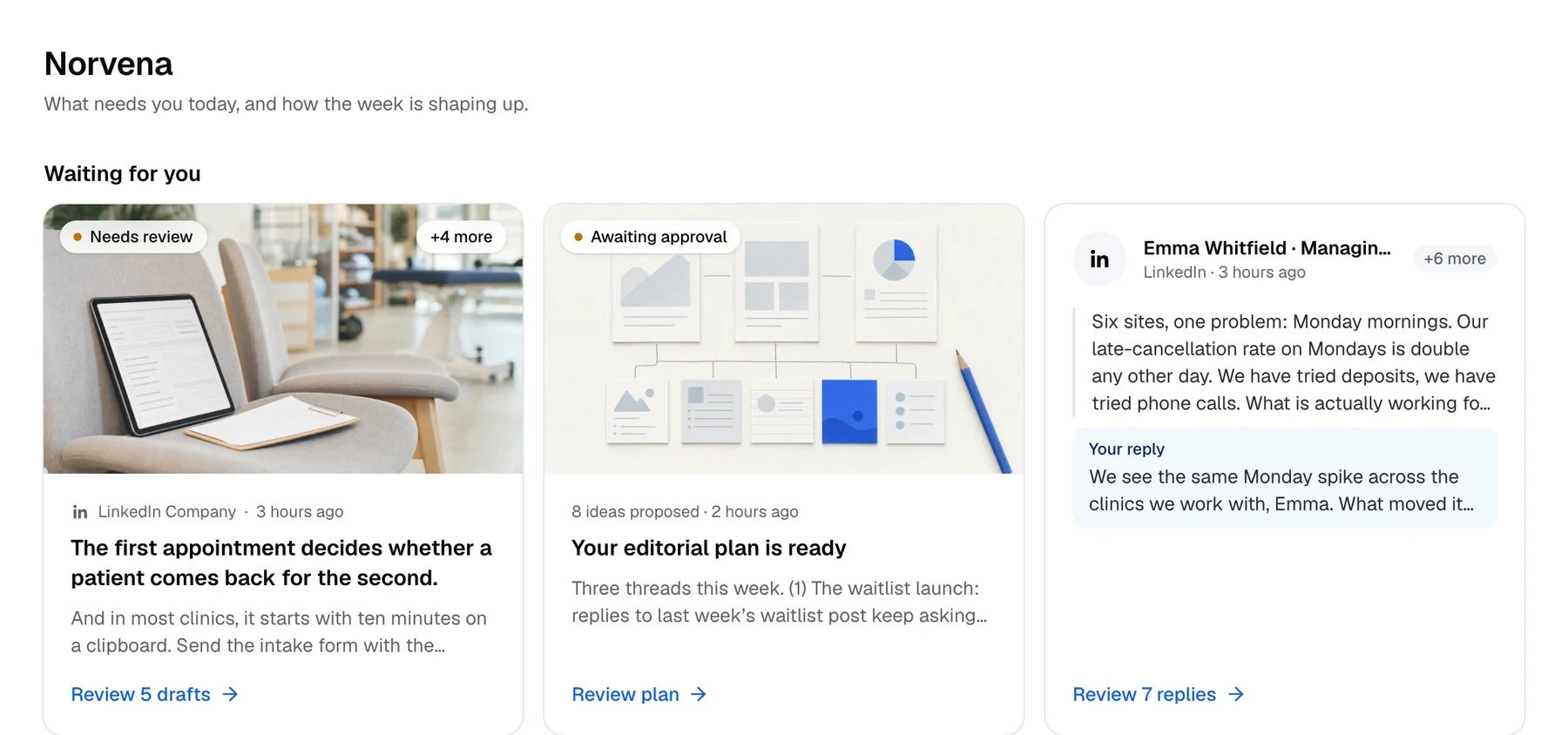
Rondo's Today screen for a brand: drafts, an editorial plan and replies waiting as cards, thirty days of views, the month's published and scheduled posts, and a topic insight.

The cycle at a glance

The Rondo content cycleTwelve stages in a loop: ideate, plan, write, verify, illustrate, approve, schedule, publish, engage, measure, learn, refresh, and back to ideate. Approve is the one stage that waits for you.1IdeateTopics from your brand, competitors and live sources2PlanA weekly plan, mixed to a funnel target3WriteIn your voice, native to each channel4VerifyEvery claim checked against sources5IllustrateAn image, in one of twenty kinds6ApproveYou decide. Nothing ships without it7ScheduleThe next free slot on each channel8PublishDirect to the platform, or handed to you9EngageComments triaged, replies drafted10MeasureTraffic, post metrics, goal progress11LearnInsights, and your edits become rules12RefreshFading posts re-promoted or rewrittenEvery week.For every brand you run.
  1. 1IdeateTopics from your brand, competitors and live sources
  2. 2PlanA weekly plan, mixed to a funnel target
  3. 3WriteIn your voice, native to each channel
  4. 4VerifyEvery claim checked against sources
  5. 5IllustrateAn image, in one of twenty kinds
  6. 6ApproveYou decide. Nothing ships without it
  7. 7ScheduleThe next free slot on each channel
  8. 8PublishDirect to the platform, or handed to you
  9. 9EngageComments triaged, replies drafted
  10. 10MeasureTraffic, post metrics, goal progress
  11. 11LearnInsights, and your edits become rules
  12. 12RefreshFading posts re-promoted or rewritten

Step by step.

  1. 01

    Ideate

    Your voice profile, industry, topics, pillars and product notes describe a keyword territory. Rondo runs grounded web search over it and returns concrete topic seeds: real, current subjects with sources attached. Competitor domains add the gaps they rank for and you do not; RSS feeds add what is happening in your field, scored 0–100 for relevance first.

    How it works
  2. 02

    Plan

    Every Monday, or on demand, a plan lands: ideas with a channel, an angle and the sources behind each, mixed to a funnel target. A focus period tilts it toward what matters now, and the review page shows whether it landed. You keep what you want. The plan costs nothing until you do.

    How it works
  3. 03

    Write

    Each kept idea is written against your voice document, natively for its channel. Blog articles get a search-intent research pass first and ship with target keyword, title tag, meta description, slug and internal links. Social posts and newsletter sections are spokes that share the argument, not the sentences. Every draft then goes through Rondo's writing rules, which take out the habits that make text read as machine-written. You can also write a draft yourself; it joins the same review.

    How it works
  4. 04

    Verify

    A separate pass with one job re-reads the finished draft, searches every checkable claim, fixes what is wrong and softens what cannot be confirmed. The draft carries the outcome as a badge: Verified, Corrected, or Unverified when the check could not complete.

    How it works
  5. 05

    Illustrate

    An art-direction pass picks the kind of image as well as its subject (from twenty forms across photography, drawn, explainer, typographic and humour) within the direction you set per brand and per channel. A post about one real subject can carry an openly licensed photograph of it from Wikimedia Commons, credited. Your product screenshots are a library it can use. Regenerate, choose the kind yourself, or replace it with your own image, GIF or short video.

    How it works
  6. 06

    Approve

    Every draft waits in an inbox. Read it, edit it in place, approve or reject, with one key each, and the next draft opens on its own. The line above Approve names the slot approving would book. Optionally a client reviewer reads first. Every publish passes one dispatch point that asserts approval from the database, so there is no route around this step.

    How it works
  7. 07

    Schedule

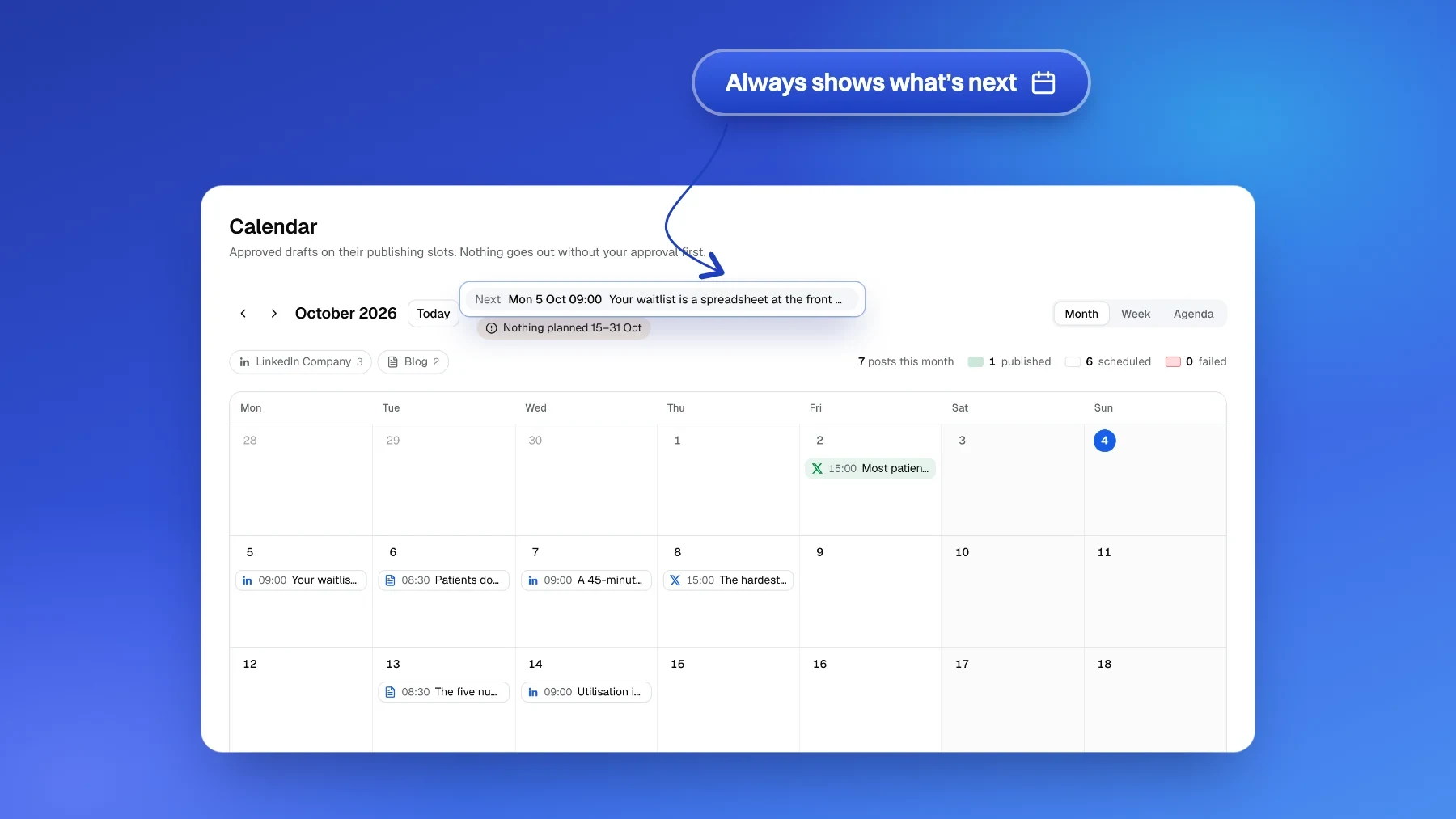
    Channels carry a weekly cadence and time slots. An approved draft takes the next free slot; the picker only offers slots that are free. Move it, publish it early, or let it go out on time. Month, week and agenda views, with the next post named and any week with nothing planned flagged.

    How it works
  8. 08

    Publish

    Direct to LinkedIn, X, Instagram, Facebook, WordPress, Shopify, Payload or any CMS by webhook. Newsletter issues are composed and handed to your Resend account. Anything Rondo cannot reach lands in a manual queue with copy and image ready. A failed publish tells you what to do next, and can be retried without going back to drafts.

    How it works
  9. 09

    Engage

    Rondo researches the biggest accounts in your field and reads their new posts on X, LinkedIn and Instagram, alongside comments and mentions on your own LinkedIn page. Each item is triaged High, Medium, Low or Skip, and the ones worth it get a reply or quote drafted in your voice. Replies on your own posts go out when you press Post; everything else opens on the platform with the draft ready for you to send.

    How it works
  10. 10

    Measure

    Post metrics from LinkedIn, X, Facebook and Instagram, blog traffic from Google Analytics or Plausible, newsletter opens and clicks from Resend, on one page, against goals for traffic, engagement and subscribers. A figure a platform cannot report stays blank rather than reading as zero.

    How it works
  11. 11

    Learn

    When you edit a draft before publishing, Rondo keeps what the difference teaches as a writing rule for your brand, one you can read, reword, switch off or replace. Rejecting a draft with a reason teaches it the same way. Insights reads 30 days of results into specific recommendations, each linking to where you would act, and only once there is enough data to read.

    How it works
  12. 12

    Refresh

    Every Sunday, plain arithmetic over your analytics finds published posts that once drew real traffic and have faded, or that still draw it and lose readers on arrival. Each gets a re-promote or rewrite suggestion, and the rewrite is told why it was asked for.

    How it works

The foundation

A voice document, not a tone slider.

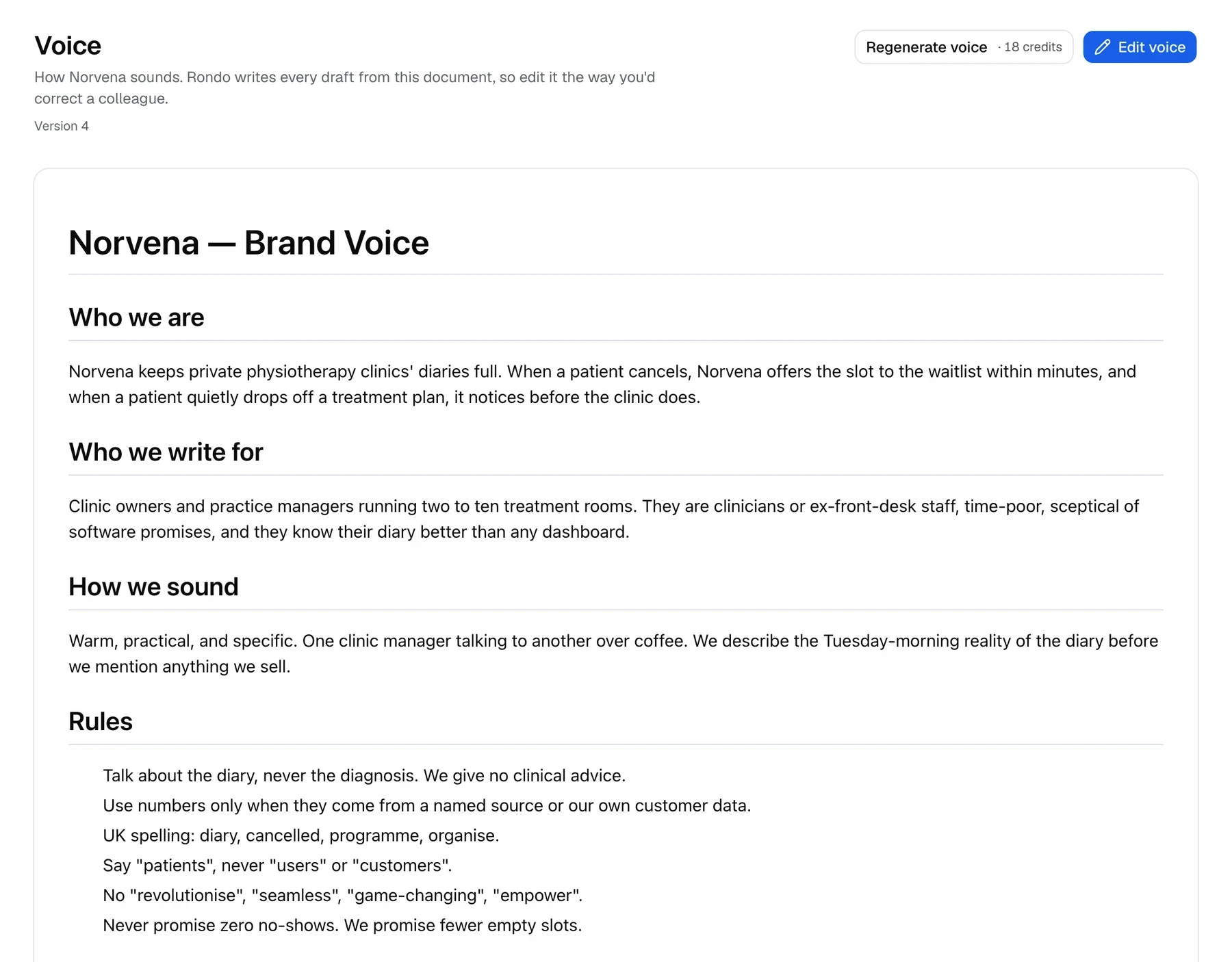
Point Rondo at your website and it writes how you sound: who you are, the rules you follow, the vocabulary you use, the things you never say. It is markdown you can read, argue with and rewrite. Every draft on every channel is written against it, and it is versioned so you can see what moved.

Product notes sit beside it: a plain document describing what you sell. Rondo writes about your product from that, and claims nothing beyond it.

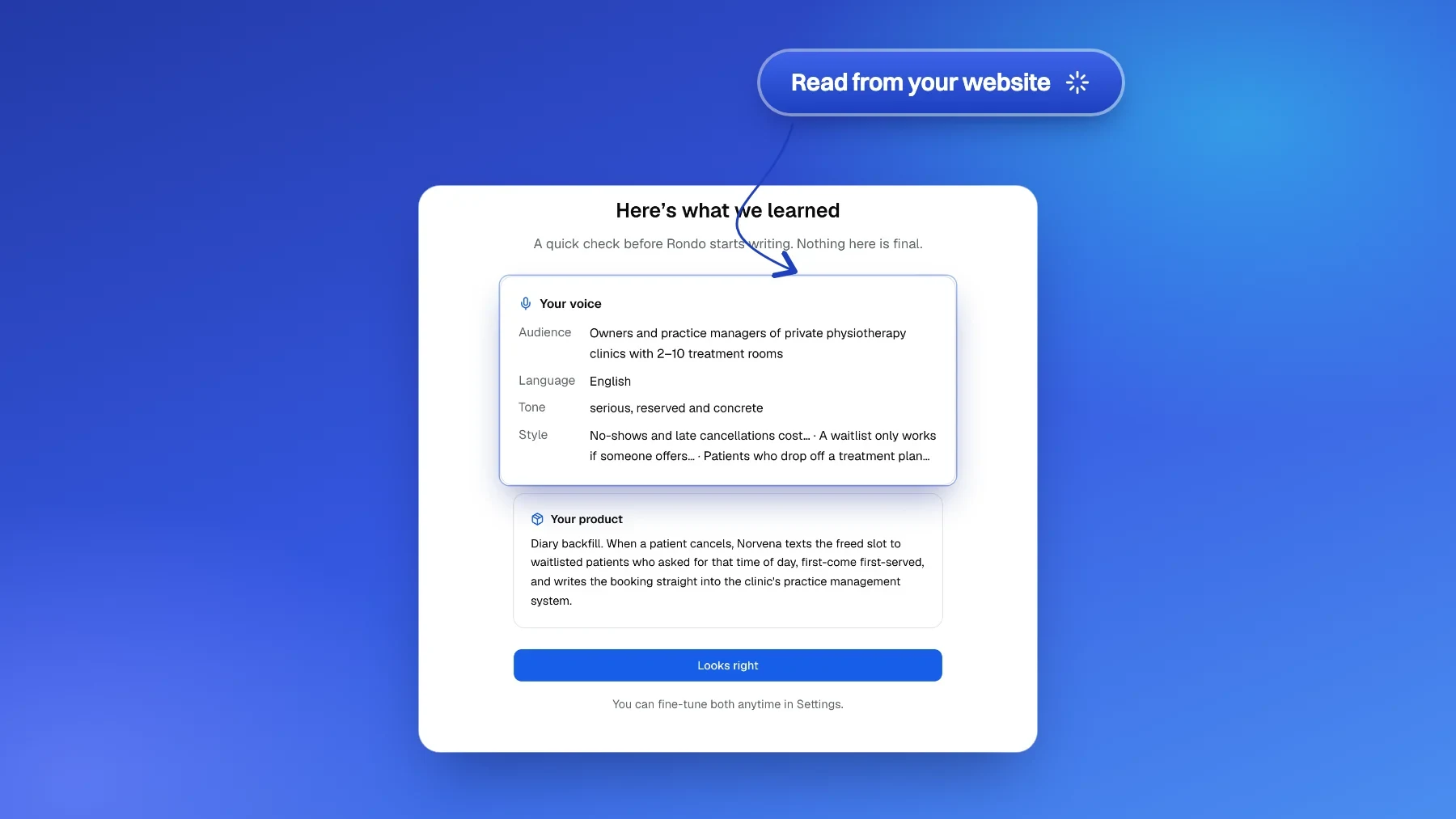
A new brand starts in a guided setup: pick a plan, let Rondo read your website, check a short summary of what it learned, connect a channel or choose to copy posts by hand, accept a posting schedule, and the first plan is on its way. Leave at any step and pick it up later where you stopped.

The guided setup's 'Here's what we learned' step: the voice Rondo read from the website (audience, language, tone and style) lifted out, the product summary beneath, and a Looks right button.Settings → Voice: the brand-voice document rendered (who we are, who we write for, how we sound, rules and vocabulary) at version 4, with Edit voice and Regenerate voice.

Stages 1–2

The plan is the first gate.

Every idea on a plan is there to move a reader closer to what you sell: naming a problem, making your way of solving it look obvious, or showing the product doing it. News from your sources is a hook for that argument, not the subject.

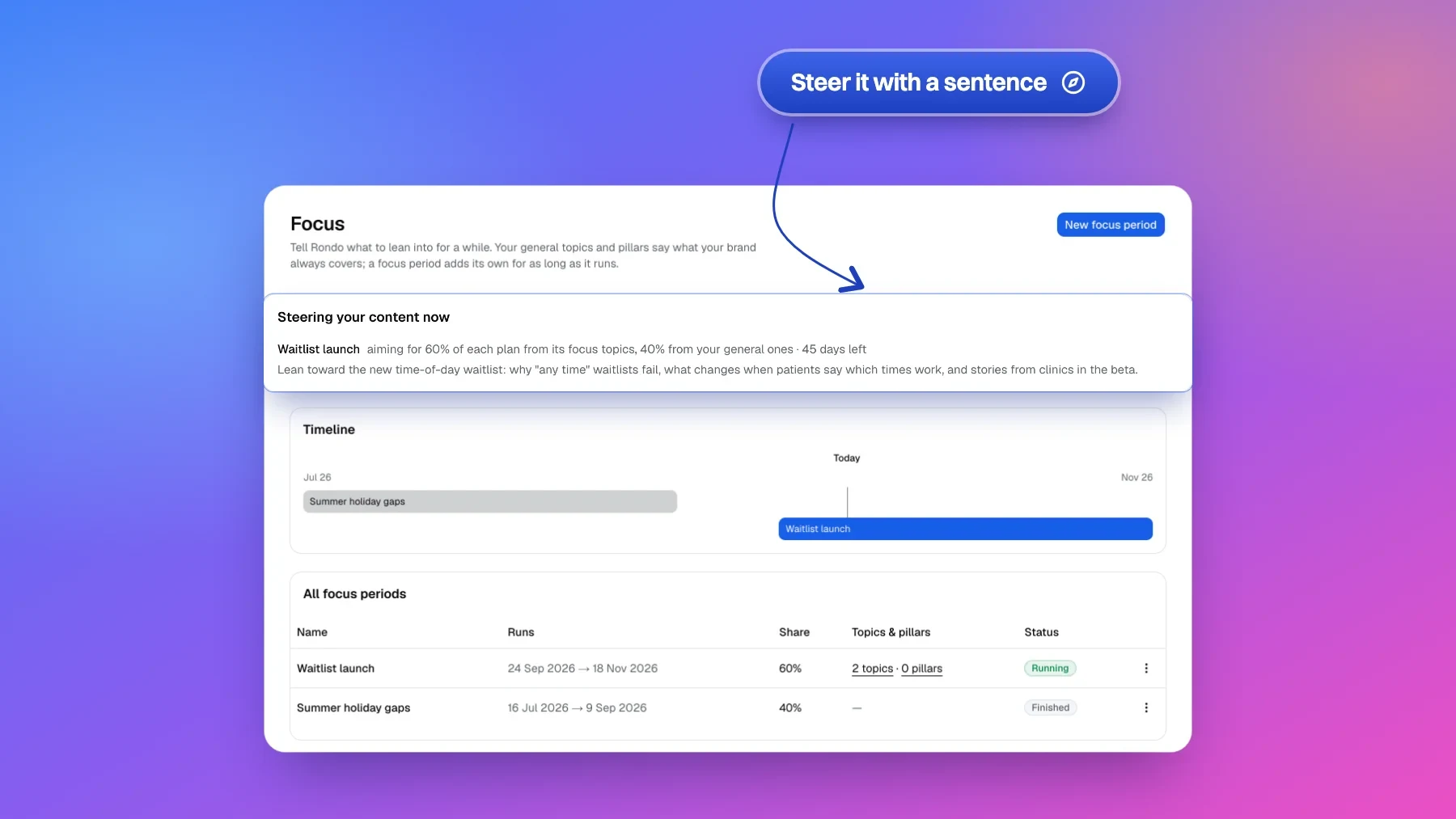
Focus periods steer the mix for a while (“lean into the launch for eight weeks”) and the plan reports target against achieved. A focus period can bring topics and pillars of its own, written from its brief and used only while it runs; your general topics are always in play. A channel that produced nothing is named, not left as a gap.

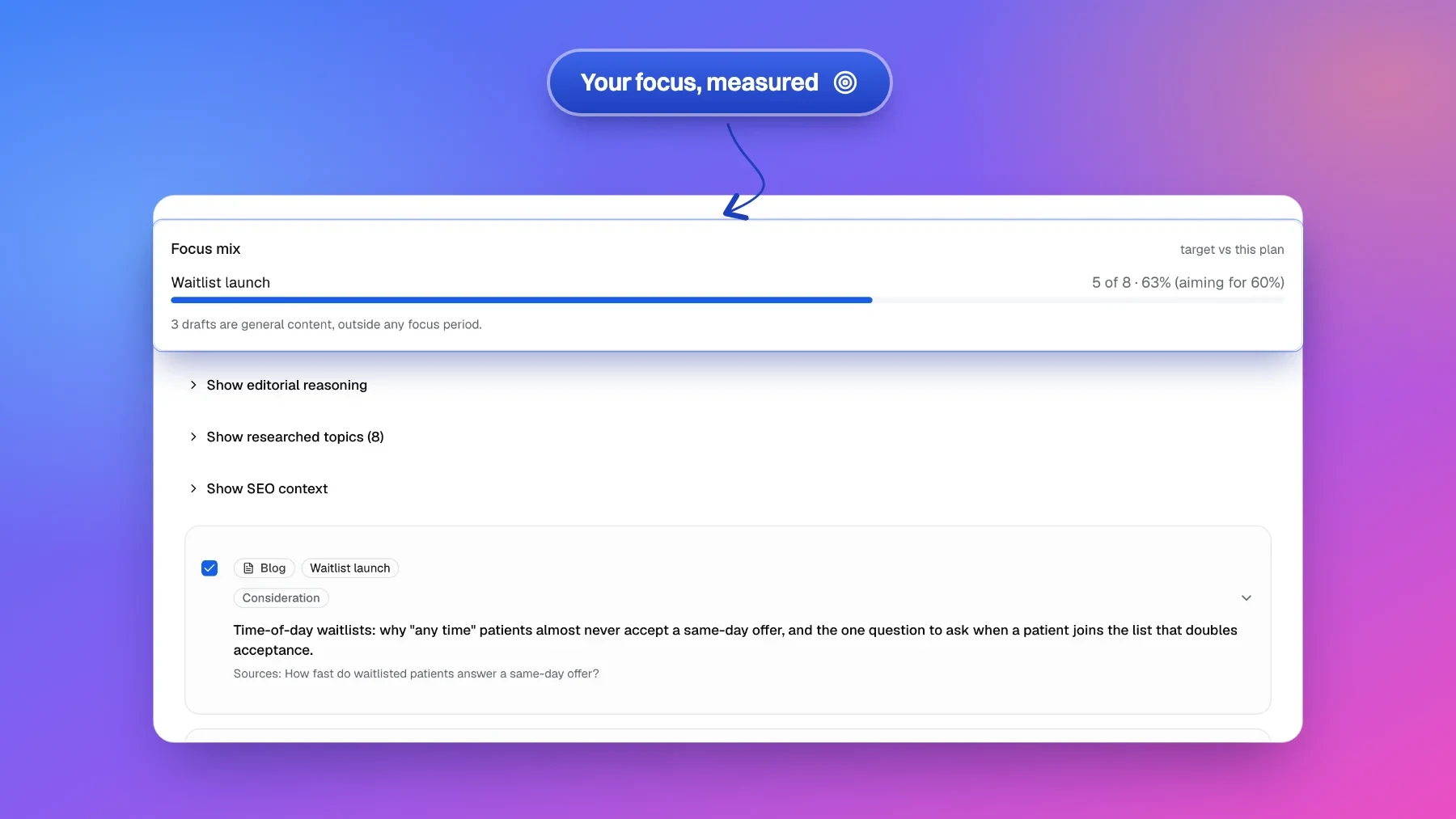
This week's editorial plan with the focus-mix bar lifted out: five of eight ideas on the running focus period.The Focus page with 'Steering your content now' lifted out (the running Waitlist launch period, its share and days left) above the timeline and the list of focus periods with their topics and pillars.

Staying current

Sources are enrichment, never a prerequisite.

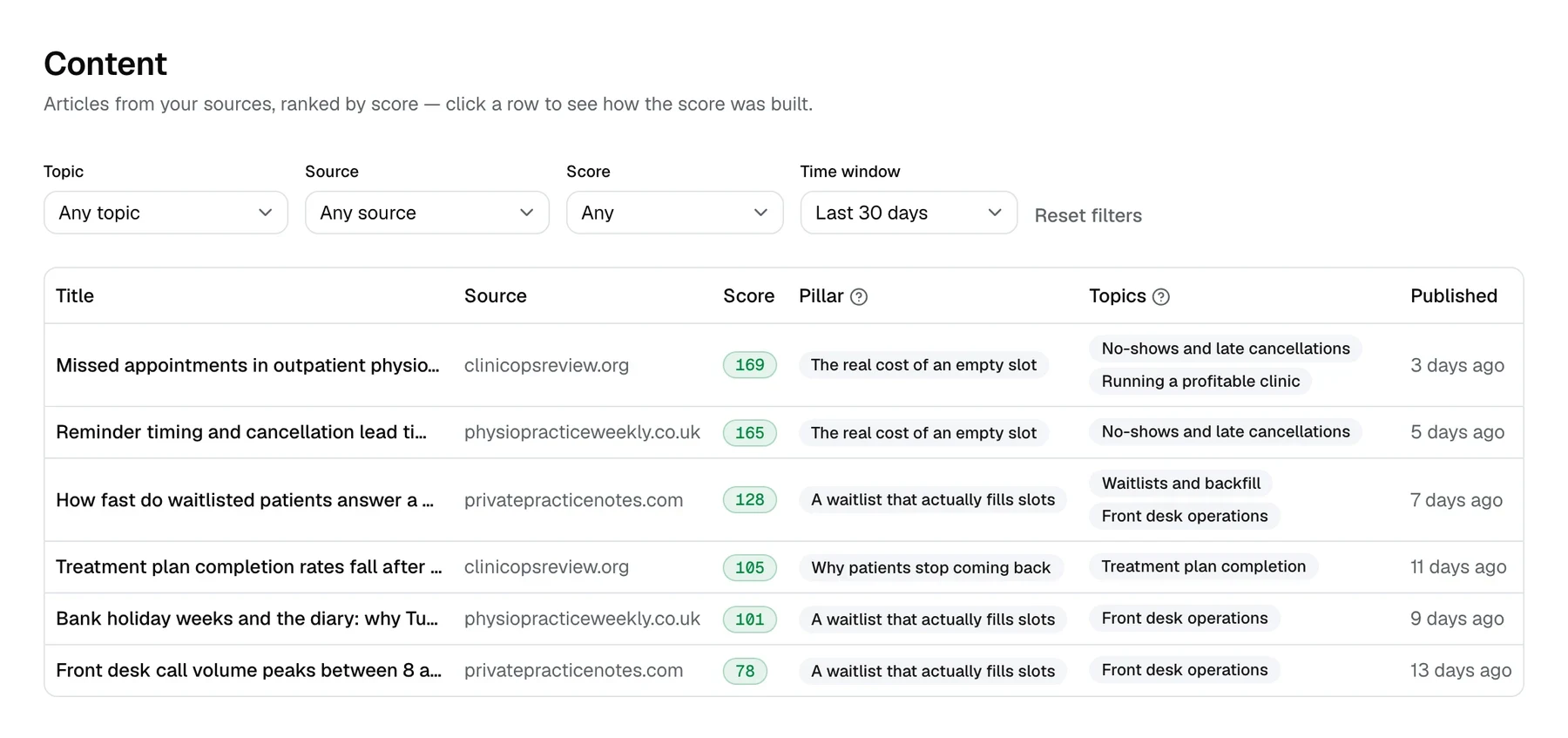
Add feeds worth watching and every article is scored 0–100 against your voice, topics and pillars, with the reasoning stored so you can see why. Items above your threshold can reach the planner; everything else stays browsable. Material a draft was written from stays spent unless you reject that draft, so a story is not re-proposed a fortnight later.

The Content screen: articles from RSS sources over the last 30 days, ranked by score, with the pillar each one supports and the topics it matched.

Stages 3–6

Written, checked, illustrated, and waiting.

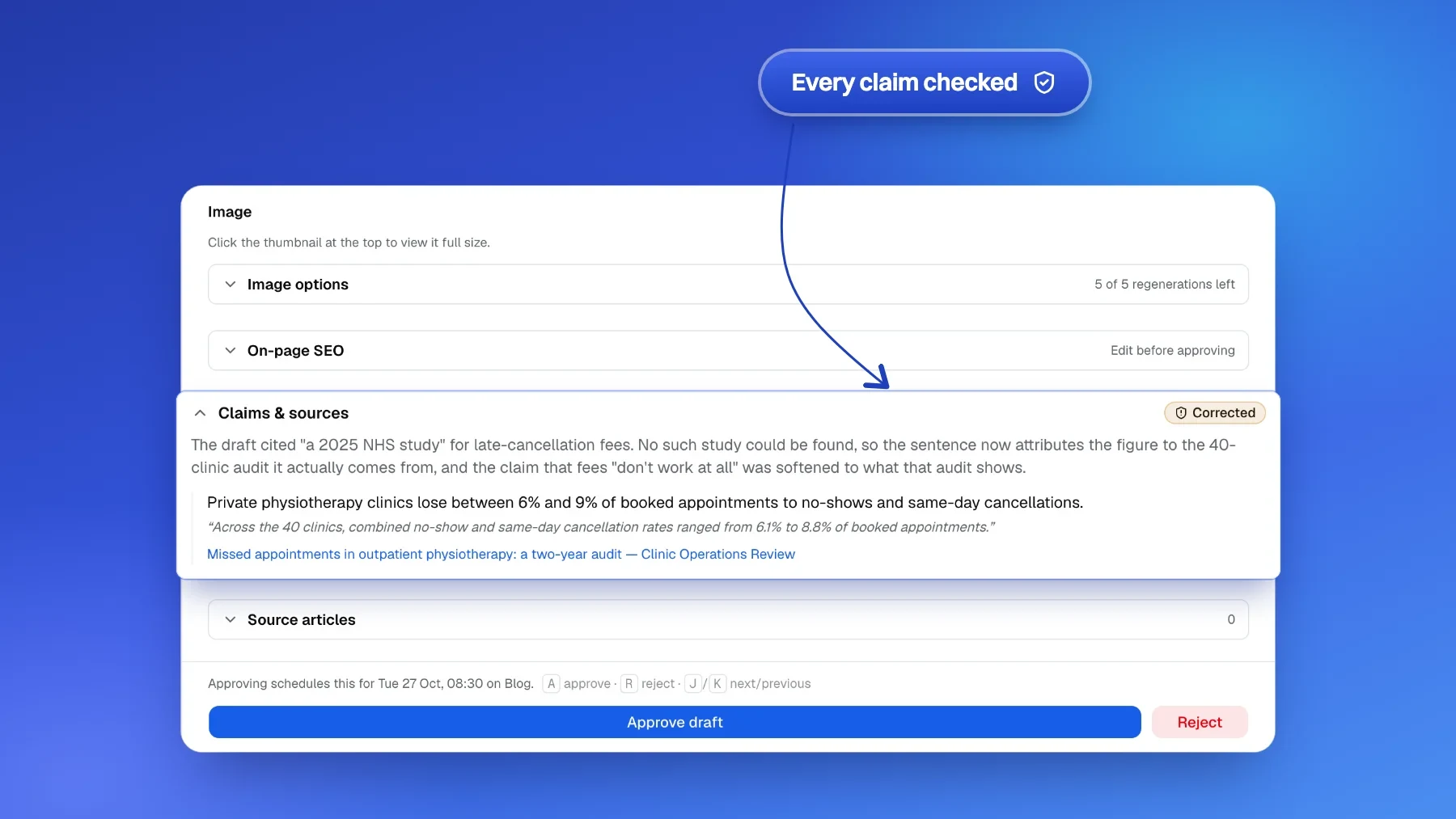
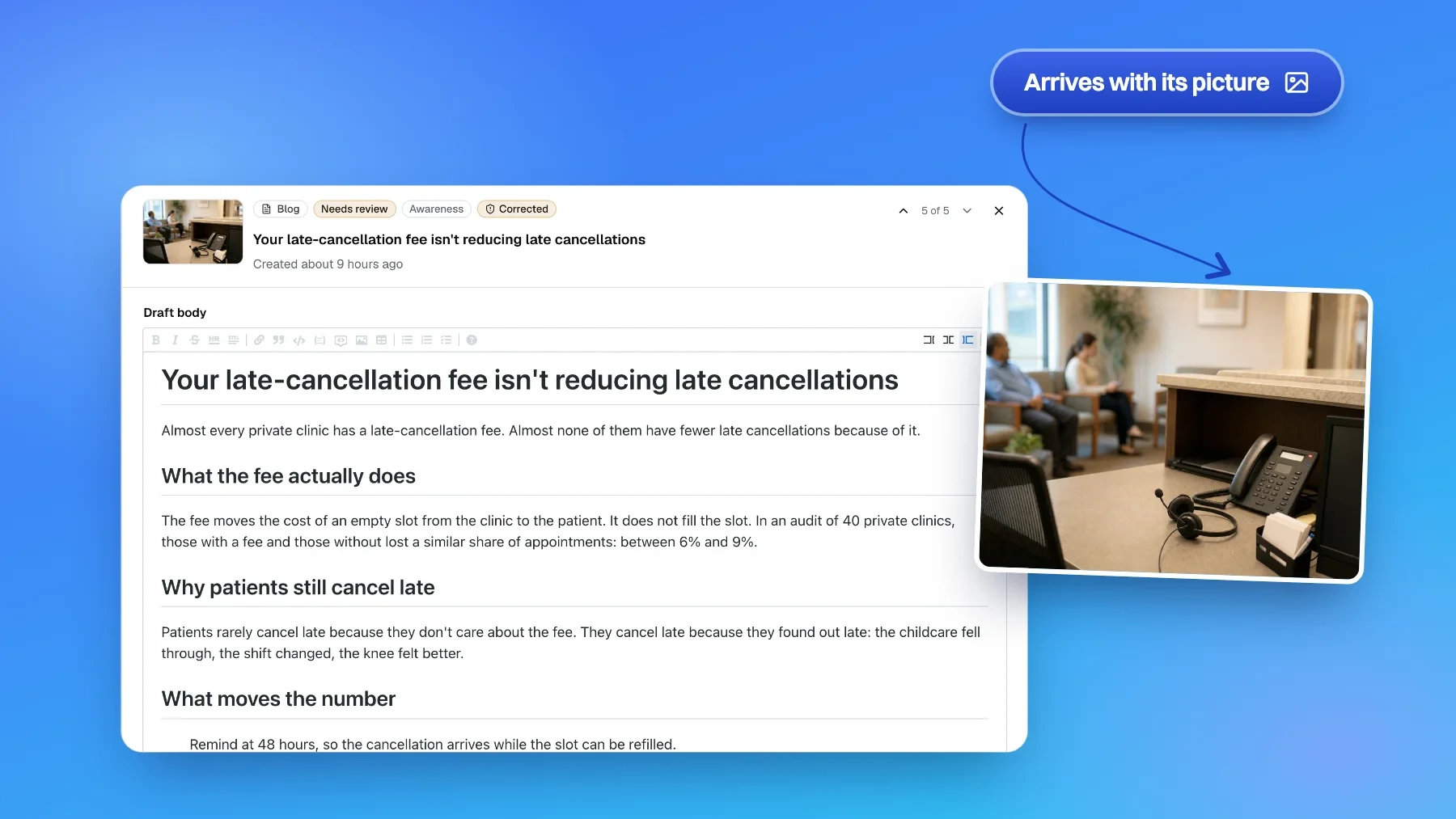
A draft arrives with its channel, funnel stage, SEO fields, fact-check badge and image. The body opens in an editor, and the claims panel shows what the fact-check changed and the source it used. Approve books the slot named above the button; Reject moves it out of the way; editing before approval teaches Rondo a rule. Nothing else happens in between.

There is no autopilot setting. Every publish, from every route, passes one dispatch point that reads the approval state from the database. It cannot be switched off because it is not a switch.

A blog draft open for review with its Claims and sources panel lifted out, marked Corrected, and the line above Approve draft naming Tuesday 27 October, 08:30 on the blog.The same draft with its photograph of a clinic front desk shown full size beside the editor.

Writing quality

Drafts you would sign with your own name.

The worry with any AI writing tool is always the same one: posts that sound like everyone else's, with a stock opener, a dash in every other line and a closing question that begs for comments. Readers spot that pattern quickly, and it makes the brand behind it look as if nobody was paying attention. Rondo is built around that worry.

Rondo spends where it shows. The drafts you publish, your newsletter sections and your replies are written by its top model tier; smaller, faster models do the sorting and scoring. Each draft is written against your voice document, which Rondo builds by reading your website and which you can read, edit and rewrite. When you edit a draft before approving it, Rondo keeps the difference as a writing rule for your brand.

A separate pass then checks the facts. It searches every checkable claim, fixes what is wrong and softens what it cannot confirm. Claims about your own product are checked against your product notes, so Rondo never promises a feature you do not have.

Then every draft goes through Rondo's writing rules, drawn from public guides to how AI text gives itself away. Em dashes and hidden characters are removed in code. If a draft leans on stock phrases, staged contrasts or bait closers, Rondo rewrites only those sentences, once, with every link and number held in place. That rewrite costs you no credits.

What the rules take out

  • Em dashes and hidden characters
  • “It’s not just X, it’s Y”
  • “Let’s dive in”
  • “In today’s fast-paced world”
  • “What do you think?” on every post
  • Words like “delve”, “tapestry” and “game-changer”

Rondo does not try to fool AI detectors, and it does not fake a human touch. It adds no typos, no slang your voice does not use, and no invented stories. Your readers are the audience, and polished writing is the floor.

You still read it first. Nothing publishes until you approve it, and there is no setting that changes that.

How Rondo keeps writing human

Before

A typical AI post

Written for this page to show the patterns

In today's fast-paced worldcanned opener, every empty appointment slot hurts your clinic. Let's dive inannouncing the point.

Here's the thingstaged reveal: it's not the waitlist. It'sit's not X, it's Y how you use it.

Moreoveroverused word, a smart waitlist doesn't just fill gaps —em dash it unlocks the full potentialAI cliché of your diary. Furthermoreconnective pile-up, it plays a crucial roleempty significance in patient retention. Additionallyconnective pile-up, it's a seamlessoverused word, robustoverused word way to streamlineoverused word your front desk.

Don't get me wrongarguing with no one, phone calls work. But the truth?staged reveal Patients don't want calls…ellipsis character

No voicemails. No phone tag. No empty rooms.staccato fragments

✅ Fewer gaps in the diary ✅ Happier patients ✅emoji bullets A calmer front desk

Not only does it save time, but itnot only, but also also adds up to a game-changerAI cliché for your bottom line. **This marks a pivotal momentempty significance for physio clinics.**markdown ZERO WASTED SLOTS, EVERshouting in caps.

Let that sink inslogan closer.

Drop your thoughtsbait closer below. What do you think?bait closer
26 writing-rule hits across 18 rules

Rondo

The same post, written to Rondo's rules

Same message, the habits taken out

On Thursday afternoon a patient cancels Friday's 9am. The front desk rings down the waitlist, leaves four voicemails, and the room sits empty on Friday morning.

The list was never short of names. Nobody had asked the people on it which times they can actually make.

Norvena asks when a patient joins the waitlist: mornings, lunchtimes or after six. When a slot opens, only the patients who said yes to that time get a text, and the first to reply takes it.

For the clinics in our beta, that meant fewer voicemails and fewer empty rooms after short-notice cancellations.

How does your front desk fill a slot that opens the evening before?

0 writing-rule hits
Both posts are examples written for this page, about filling cancelled physio appointments from a waitlist for Norvena, our demo brand. Every highlight is a pattern Rondo's writing rules flag when run on the post; run through the same check, the post on the right comes back clean.

Stages 7–10

Out the door, and back again.

October on the calendar: posts on their slots with channel icons and times, and the Next line lifted out.

Schedule and publish

Slots per channel, set once. Approved drafts take the next free one and go out on time, or early, when you say so. Failures come back as instructions, not error dumps.

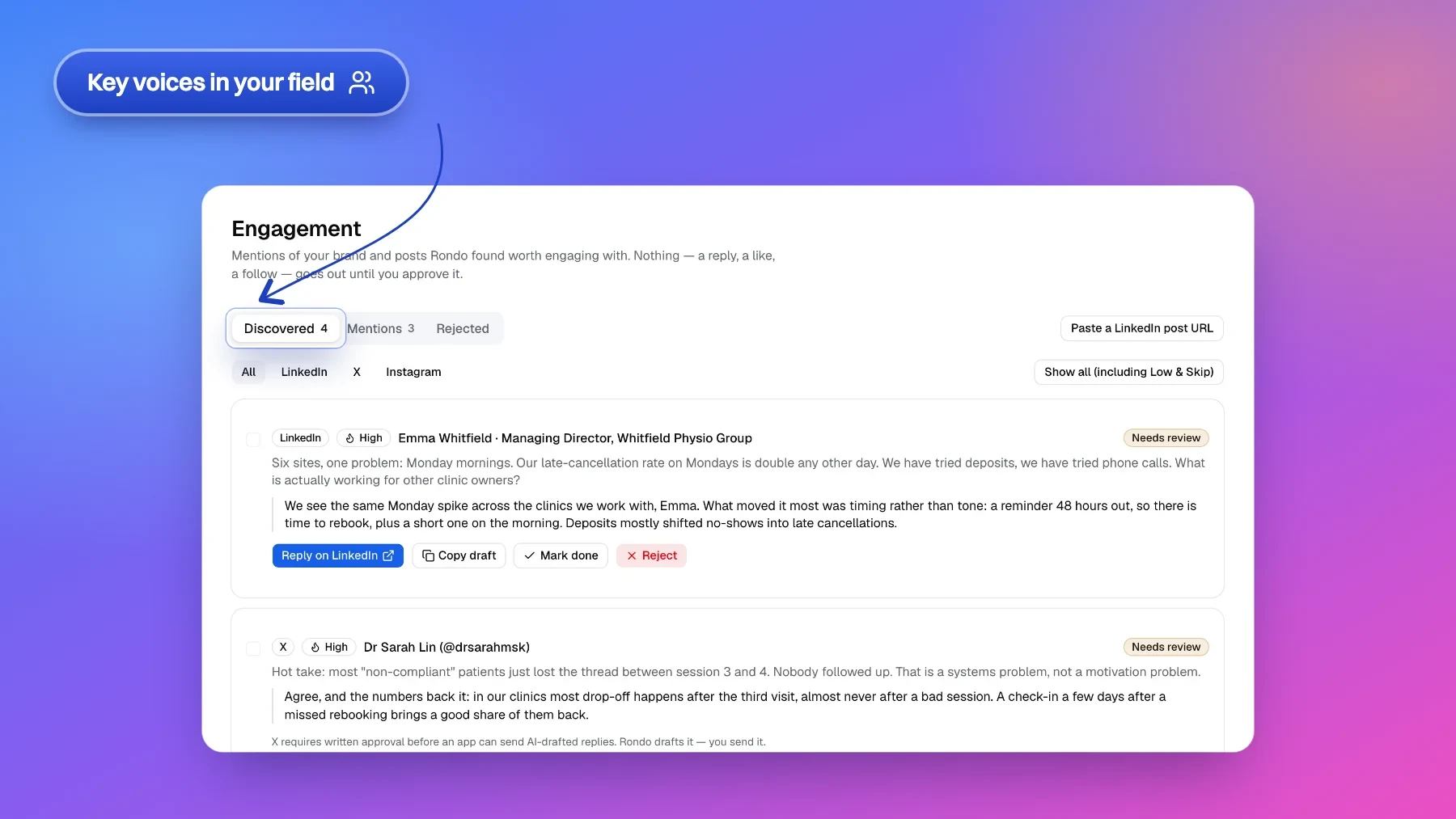
The Engagement inbox on its Discovered tab: posts from key voices on LinkedIn and X, triaged High, each with a drafted reply.

Engage

Key voices in your field and comments on your posts, triaged by worth, with a reply drafted in your voice. Nothing is sent until you say so.

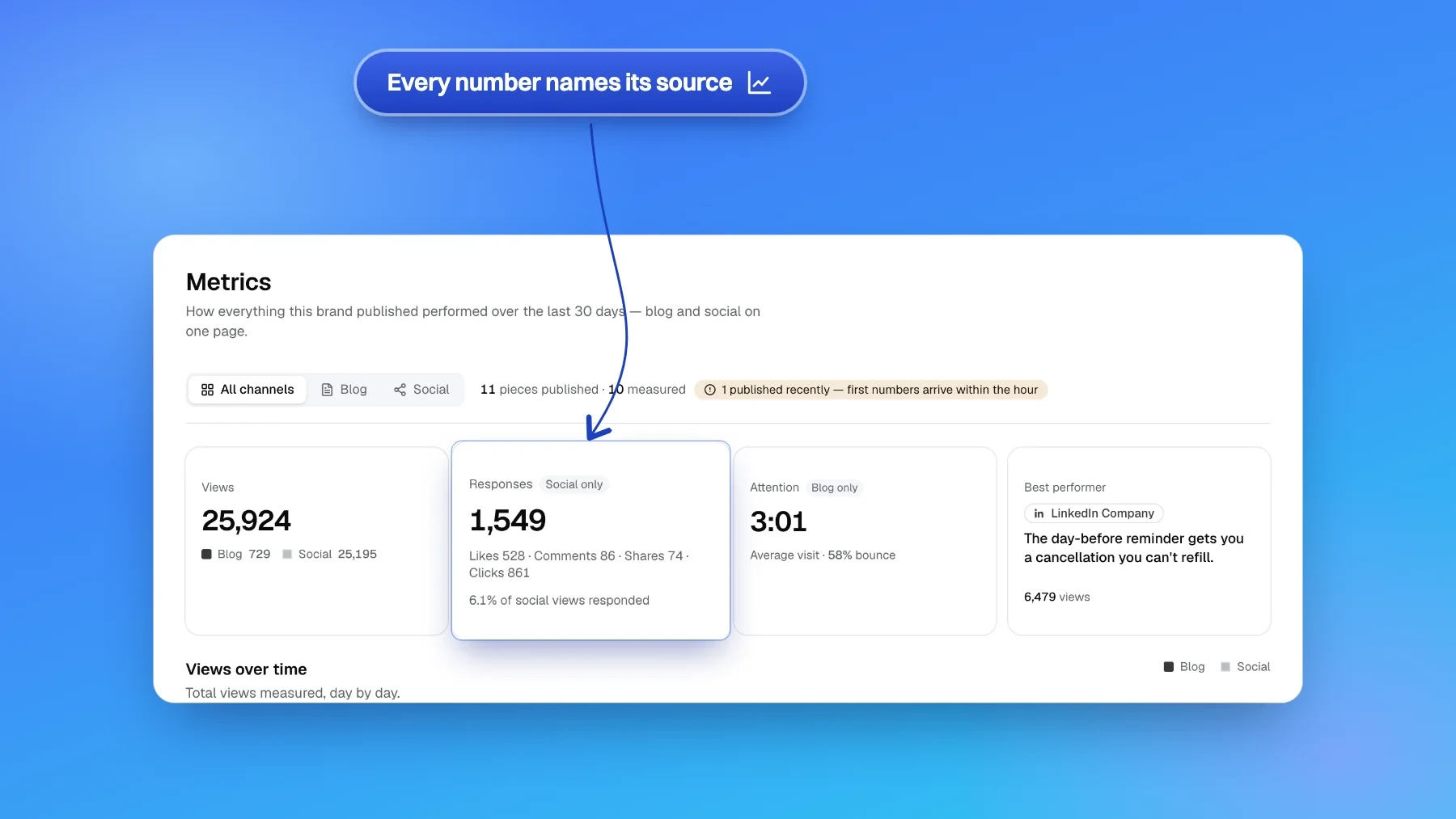
The Metrics screen: views, responses, attention and best performer across blog and social, with the Responses tile lifted out.

Measure

Blog and social on one page, against goals you set. Every number names its source, and absent is never shown as zero.

Stage 9

Be seen where your field already reads.

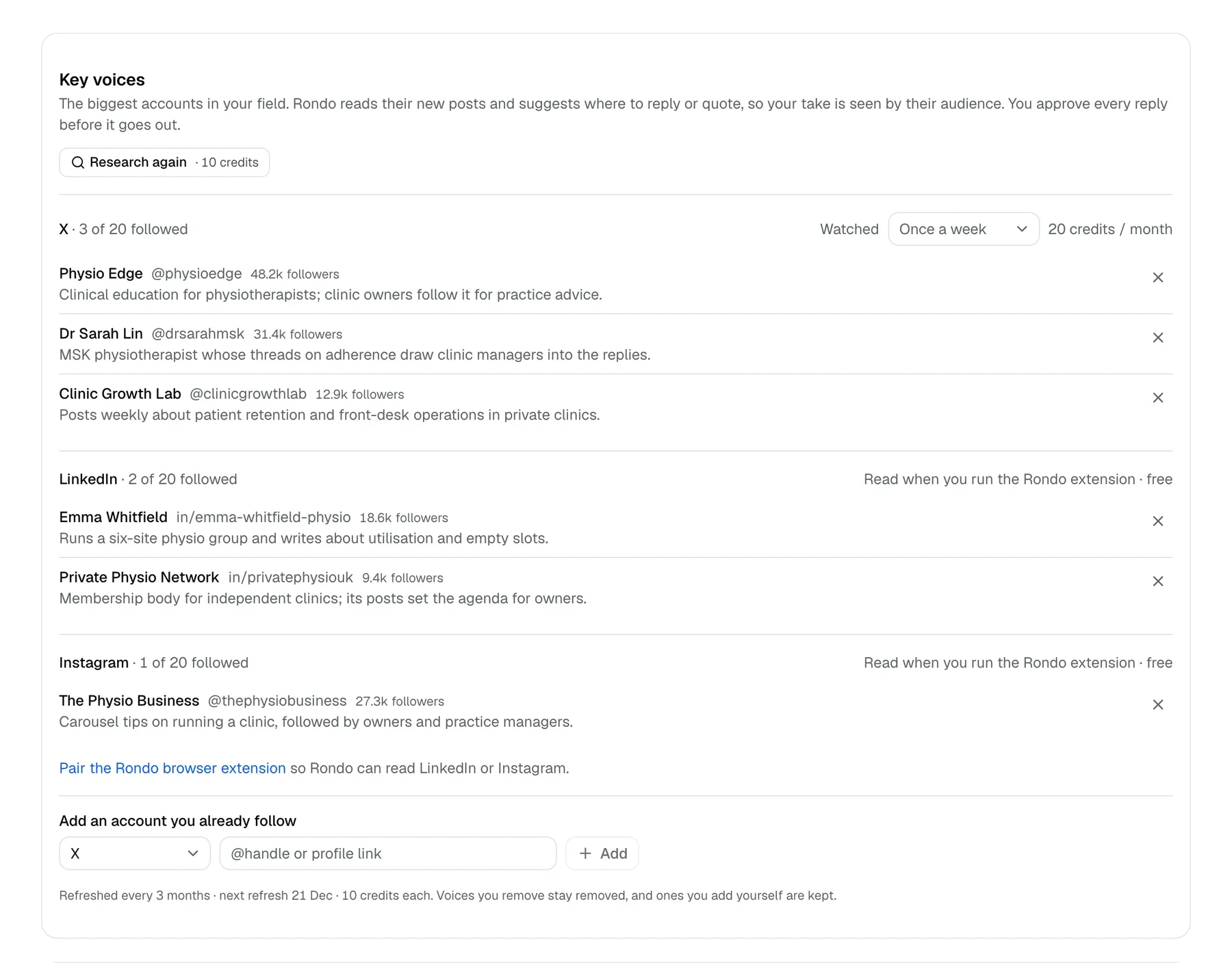
Replying under an account with a real audience gets your take in front of it. Rondo researches the biggest voices in your field (on X, LinkedIn and Instagram), refreshes the list every three months, and reads their new posts. You can remove any of them, or add accounts you already follow.

LinkedIn and Instagram do not let anyone read other people's posts through an API, so a small Rondo browser extension reads them in your own signed-in browser, slowly, like you would. It only reads: it never likes, comments, follows or connects.

Engagement is on the Standard plan with weekly watches, and on Advanced with daily ones. Rondo posts only replies to comments on your own LinkedIn page, when you press Post; everything else opens on the platform with the draft ready, and you send it.

Settings → Watches, Key voices: three accounts followed on X, two on LinkedIn and one on Instagram, each with its follower count and why it matters to the brand.

Stages 11–12

Feedback loops you can read.

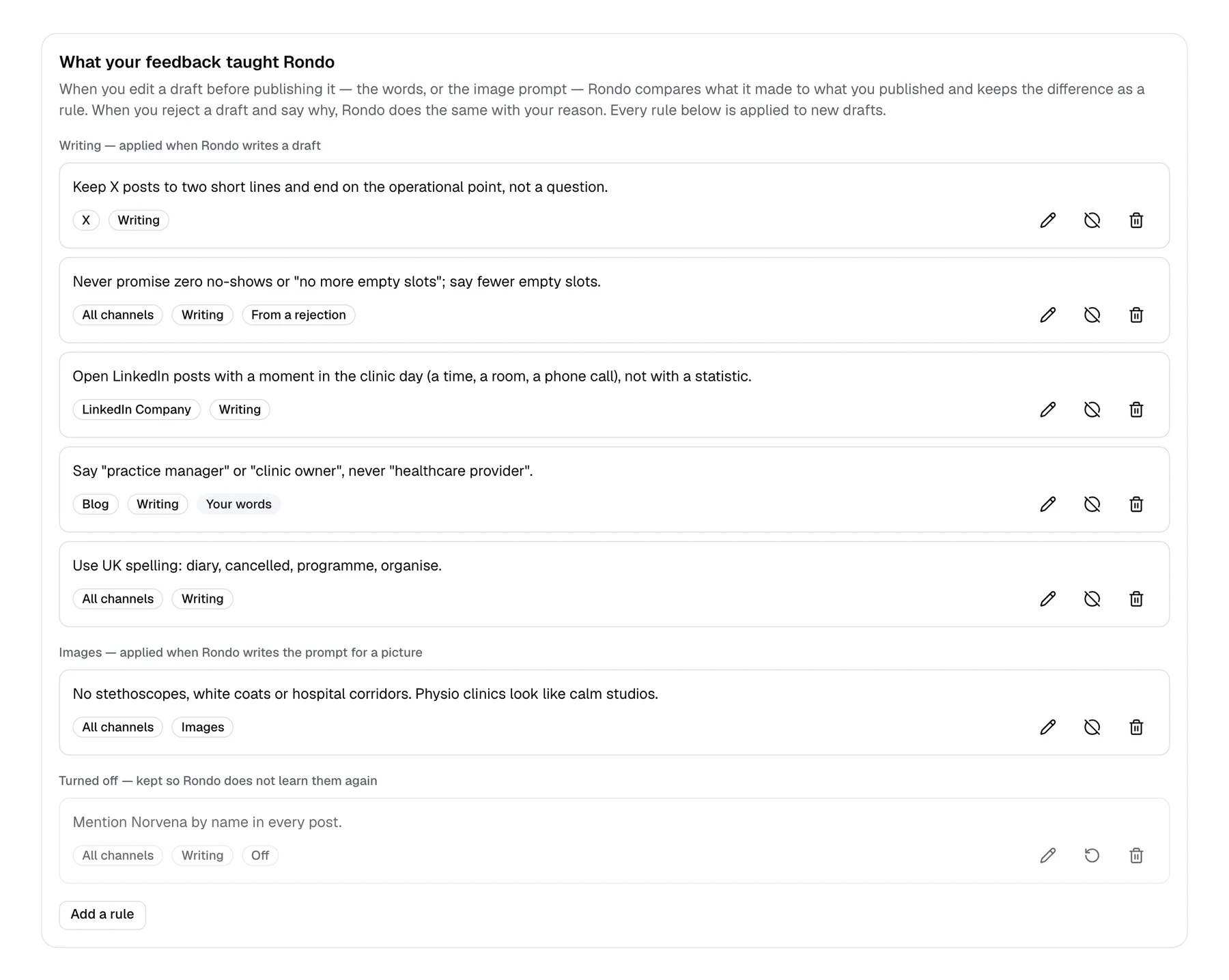
Three things feed the next round. Your edits become written rules under Settings → Voice. Insights turn a month of metrics, engagement and publishing history into recommendations with a link each. Rondo guides, it never rewrites your strategy. And the Sunday lifecycle pass flags posts that have faded, or that readers abandon on arrival, for a re-promote or a rewrite.

Focus periods close the loop from your side: a sentence of direction, a share, a date range, and every plan after it reports whether it followed.

Settings → Voice, 'What your feedback taught Rondo': writing and image rules learned from edited and rejected drafts, with their channel and kind, and controls to edit, switch off or delete each one.

Integrations.

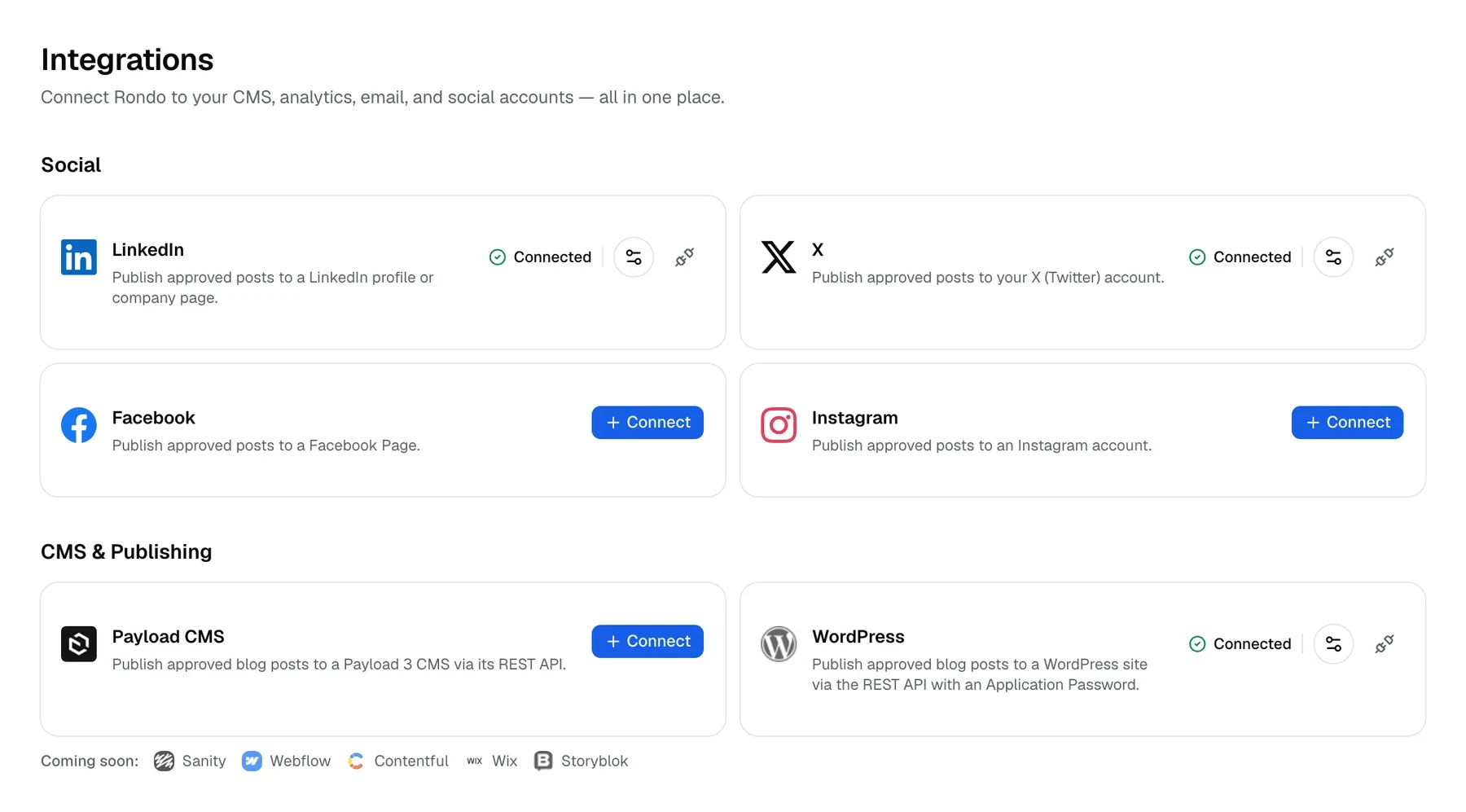
Rondo separates what to publish from where it goes, so adding a destination never means rebuilding your content. Three kinds of connection.

Rondo's Integrations screen: LinkedIn, X, WordPress, Plausible and Resend connected; Facebook, Instagram, Payload CMS and Google Analytics ready to connect.

Publishes to

  • LinkedIn company pages and personal profiles
  • X posts and threads
  • Instagram connected account
  • Facebook pages
  • WordPress over the core REST API
  • Shopify articles on your store blog
  • Payload CMS Payload 3, REST API
  • Any CMS a generic webhook you describe

Reads back from

  • Google Analytics 4 blog traffic, bounce, visit length
  • Plausible blog traffic
  • LinkedIn post metrics and comments on your page
  • X impressions, likes, replies, reposts and link clicks
  • Facebook & Instagram reach, reactions, comments, shares
  • Resend delivery, opens and clicks
  • Rondo browser extension reads LinkedIn and Instagram key voices in your own browser; read-only

Talks to you on

  • Telegram a plan is ready; drafts are written; no buttons, ever
  • Email sign-in links and failure alerts that say what to do
  • Client review an outside reader approves or sends back first

Rondo does not send your newsletter to your list. It composes the issue and hands it to the sender you already use, which keeps the list and the deliverability.Setup guides for every integration

See it run on your brand.

Sign in, give Rondo your website, and a guided setup takes you to the first plan. A 14-day free trial on every plan, no card needed.